




软件

产品


在这里插入代码片
---
title: "Multimodal intersection analysis (MIA) tutorial"
author: "Reuben Moncada"
date: "11/3/2020"
output: html_document
---


```{r setup, include = FALSE}
knitr::opts_chunk$set(echo = TRUE)
Let’s begin by loading the filtered scRNA-seq data for PDAC-A (GEO accession GSE111672) and converting the data to a Seurat object for analysis.
The scRNA-seq expression matrix from GEO already has cluster annotations as the column header, so we won’t need to cluster the data.
library(Seurat)
library(dplyr)
library(stringi)
library(ggplot2)
library(reshape2)
library(scales)
# Load PDAC-A scRNA-seq expression matrix
sc <- read.table('GSE111672_PDAC-A-indrop-filtered-expMat.txt', sep = '\t', header = FALSE)
cluster_assignments <- as.character(sc[1,])[-(1:1)] # Extract cluster annotations
genes <- sc[-(1:1),1]                               # Extract genes
sc <- sc[-(1:1),-(1:1)]                             # Remove genes and cluster annotations from expression matrix
rownames(sc) <- make.names(genes, unique = TRUE)    # Set rownames of expression matrix to the list of genes
sc <- CreateSeuratObject(sc, assay = 'RNA')         # Create Seurat object
Idents(sc) <- cluster_assignments                   # Use the original cluster annotations as the cell identities
# Collapse subpopulations into broader cell type annotations
sc <- RenameIdents(object = sc, 'Macrophages A' = 'Macrophages')
sc <- RenameIdents(object = sc, 'Macrophages B' = 'Macrophages')
sc <- RenameIdents(object = sc, 'Ductal - terminal ductal like' = 'Ductal')
sc <- RenameIdents(object = sc, 'Ductal - APOL1 high/hypoxic' = 'Ductal')
sc <- RenameIdents(object = sc, 'Ductal - MHC Class II' = 'Ductal')
sc <- RenameIdents(object = sc, 'Ductal - CRISP3 high/centroacinar like' = 'Ductal')
sc <- RenameIdents(object = sc, 'mDCs A' = 'mDCs')
sc <- RenameIdents(object = sc, 'mDCs B' = 'mDCs')

Now we’ll load the PDAC-A-ST1  ST  data. The column headers of the data contain the tissue coordinates of each ST spot.
# Load PDAC-A-ST1 expression matrix:
st <- read.table('GSM3036911_PDAC-A-ST1-filtered.txt', sep = '\t', header = TRUE)
genes <- st[,1]
st <- st[,-(1:1)]
rownames(st) <- make.names(genes, unique = TRUE)
st <- CreateSeuratObject(st, assay = 'Spatial')
# Create data frame of spot tissue_coordinates
tissue_coord <- data.frame(row.names = colnames(st))
for (i in colnames(st)) {
tissue_coord[i,'X'] <- (strsplit(sub('X', '', as.name(i)), 'x') %>% unlist())[1] %>% as.integer()
tissue_coord[i,'Y'] <- (strsplit(sub('X', '', as.name(i)), 'x') %>% unlist())[2] %>% as.integer()
}
Let’s normalize our scRNA-seq data prior to marker gene identification, and visualize our cell types with tSNE:sc <- NormalizeData(sc, normalization.method = "LogNormalize", scale.factor = median(sc$nCount_RNA), verbose = FALSE)
sc <- ScaleData(sc, features = rownames(sc), verbose = FALSE)
sc <- FindVariableFeatures(sc, selection.method = "vst", nfeatures = 1000, verbose = FALSE)
sc <- RunPCA(sc, features = VariableFeatures(object = sc), verbose = FALSE)
sc <- RunTSNE(sc, dims = 1:30, verbose = FALSE)
# Visualize cell types
DimPlot(sc, reduction = 'tsne', label = TRUE, pt.size = 0.5)
sc.markers <- FindAllMarkers(sc, only.pos = TRUE, test.use = 't', min.pct = 0.25, logfc.threshold = 0.25, verbose = FALSE)
sc.markers['cluster'] %>% summary(maxsum=50)

Switching back to the ST data:
Since we don’t have cluster annotations, let’s cluster the ST data:
st <- NormalizeData(st, normalization.method = "LogNormalize", scale.factor = median(st$nCount_Spatial), verbose = FALSE)
st <- ScaleData(st, features = rownames(st), verbose = FALSE)
st <- FindVariableFeatures(st, selection.method = "vst", nfeatures = 1000, verbose = FALSE)
st <- RunPCA(st, features = VariableFeatures(object = st), verbose = FALSE)
st <- FindNeighbors(st, dims = 1:10, verbose = FALSE)
st <- FindClusters(st, resolution = 0.5, verbose = FALSE)
# Add clustering assignments to tissue tissue_coordinate data frame
tissue_coord$clusters <- Idents(st) %>% unlist() %>% as.character()
# Visualize clusters
ggplot(tissue_coord, aes(x=X, y=Y, color=clusters)) +
geom_point(shape = 15, size = 5.5) +
theme_minimal() +
theme(axis.text.x=element_blank(), axis.text.y=element_blank(),
axis.title.x = element_blank(), axis.title.y = element_blank(),
panel.grid.major = element_blank(), panel.grid.minor = element_blank())
The clusters generally match the cluster assignments in the manuscript, so we can rename the clusters based on our prior knowledge:# Cluster 0 is stroma, cluster 1 is the duct epithelium, cluster 2 is the cancer region, and cluster 3 is pancreatic tissue.
new.cluster.ids <- c('Stroma','Duct epithelium','Cancer','Pancreatic tissue')
names(new.cluster.ids) <- levels(st)
st <- RenameIdents(st, new.cluster.ids)
tissue_coord$clusters <- Idents(st) %>% unlist() %>% as.character()
ggplot(tissue_coord, aes(x=X, y=Y, color=clusters)) +
geom_point(shape = 15, size = 5.5) +
theme_minimal() +
theme(axis.text.x=element_blank(), axis.text.y=element_blank(),
axis.title.x = element_blank(), axis.title.y = element_blank(),
panel.grid.major = element_blank(), panel.grid.minor = element_blank())
st.markers <- FindAllMarkers(st, only.pos = TRUE, logfc.threshold = 0.1, test.use = 't',verbose = FALSE)
st.markers['cluster'] %>% summary()
Now that we have a set of marker genes for the cell types and for the ST tissue regions, we can now integrate both datasets with MIA to determine where the scRNA-seq defined cell types localize in the tissue.
Briefly, MIA uses the hypergeometric cumulative distribution to measure the enrichment of cell-type specific marker genes (from scRNA-seq) within a list of tissue-region specific genes (from ST). We use this as a proxy for estimating the likelihood each cell type is localized to a given tissue region.
First, let’s compile a list of marker genes for both the ST and scRNA-seq data:
# Create a list object containing the marker genes for each ST region:
st.clusts <- Idents(st) %>% levels()
N <- length(st.clusts)
st.marker.list <- vector(mode = 'list', length = N)
names(st.marker.list) <- st.clusts
for(i in st.clusts) {
    st.marker.list[[i]] <- st.markers[st.markers$cluster == i,'gene']
}
# Create a list object containing the marker genes for each cell type:
sc.clusts <- Idents(sc) %>% levels()
M <- length(sc.clusts)
sc.marker.list <- vector(mode = 'list', length = M)
names(sc.marker.list) <- sc.clusts
for (i in sc.clusts) {
  sc.marker.list[[i]] <- sc.markers[sc.markers$cluster == i,'gene']
}

Let’s first demonstrate MIA with a single example: fibroblasts (scRNA-seq) and the cancer region (ST):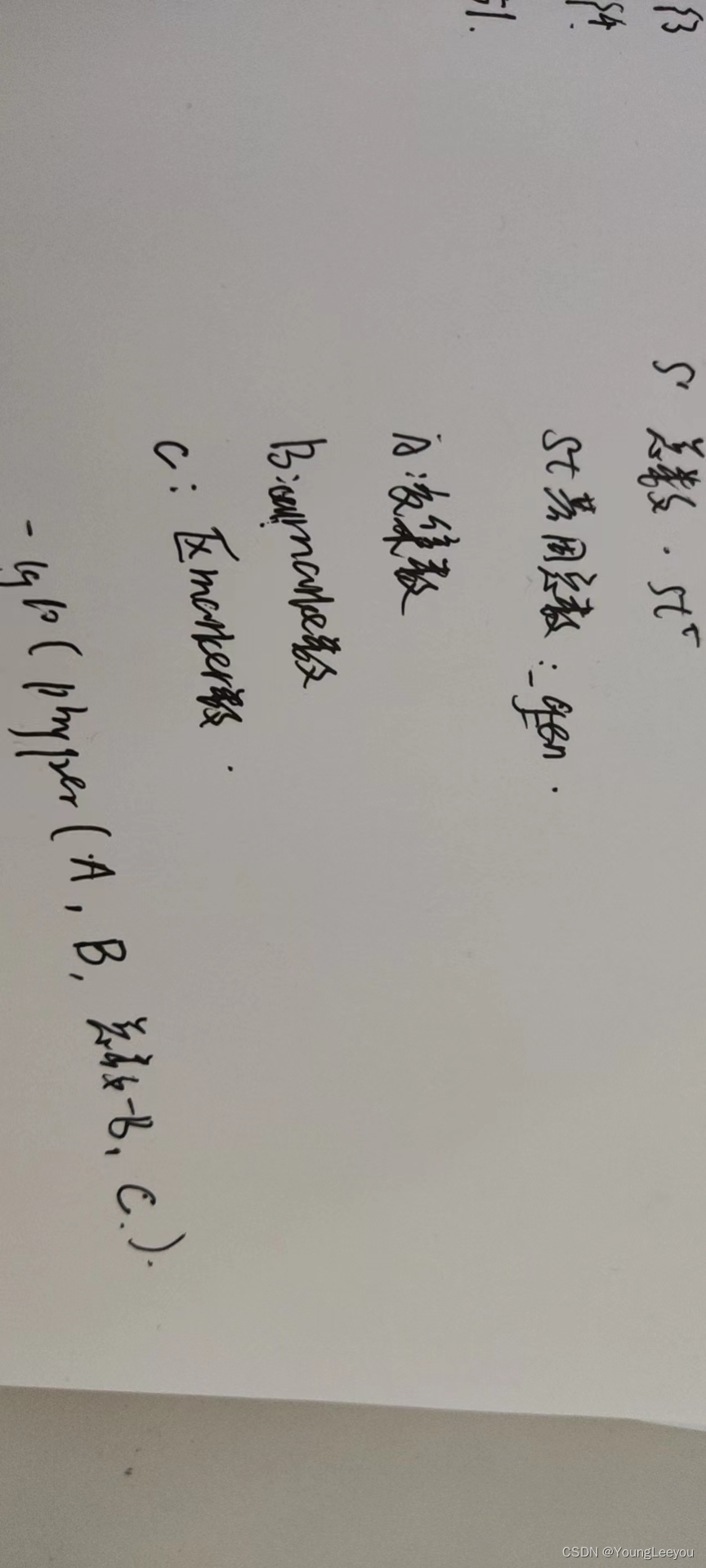
gene.universe         <- length(rownames(st))
cell.type.markers     <- sc.marker.list[["Fibroblasts"]] # Genes specific to fibroblasts
tissue.region.markers <- st.marker.list[["Cancer"]]      # Genes specific to the cancer region
common.genes          <- intersect(cell.type.markers,    # Common genes between these two gene sets
                                   tissue.region.markers)
# MIA:
A <- length(common.genes)
B <- length(cell.type.markers)
C <- length(tissue.region.markers)
enr <- -log10(phyper(A, B, gene.universe-B, C, lower.tail = FALSE))
dep <- -log10(1-phyper(A, B, gene.universe-B, C, lower.tail = FALSE))
if (enr < dep) {
  MIA.results <- -dep
} else {
  MIA.results <- enr
}
print(MIA.results)

What this signifies is that the fibroblast genes are significantly enriched within the genes specific to the cancer region of the tissue.
With a -log10(p-value) of ~13, one way to think about this is that there’s approximately a 0.00000000000001% chance we observed such an overlap between the cell-type and tissue-region genes simply by chance.
In parallel we also test for cell type depletion by computing -log10(1-p). Here, we are estimating the likelihood for an observed lack of overlap between gene sets.
Let’s use MIA to determine the cell type enrichments for all cell types and tissue regions:
# Initialize a dataframe for us to store values in:
N <- length(st.clusts) ; M <- length(sc.clusts)
MIA.results <- matrix(0,nrow = M, ncol = N)
row.names(MIA.results) <- sc.clusts
colnames(MIA.results) <- st.clusts
# Gene universe
gene.universe <- length(rownames(st))
# Loop over ST clusters
for (i in 1:N) {
# Then loop over SC clusters
for (j in 1:M) {
genes1 <- st.marker.list[[st.clusts[i]]]
genes2 <- sc.marker.list[[sc.clusts[j]]]
# Hypergeometric
A <- length(intersect(genes1,genes2))
B <- length(genes1)
C <- length(genes2)
enr <- -log10(phyper(A, B, gene.universe-B, C, lower.tail = FALSE))
dep <- -log10(1-phyper(A, B, gene.universe-B, C, lower.tail = FALSE))
if (enr < dep) {
MIA.results[j,i] = -dep
} else {
MIA.results[j,i] = enr
}
}
}
# Some results were -Inf...check why this is the case...
MIA.results[is.infinite(MIA.results)] <- 0
# Visualize as heatmap
heatmap_df <- data.frame('Cell types' = melt(MIA.results)[,1],
                         'Tissue regions' = melt(MIA.results)[,2],
                         enrichment = melt(MIA.results)[,3])
ggplot(data = heatmap_df, aes(x = Tissue.regions, y = Cell.types, fill = enrichment)) +
  geom_tile() +
  scale_fill_gradient2(low = "navyblue", high = "red", mid = "white",
                       midpoint = 0, limit = c(-10,10), space = "Lab",
                       oob=squish, name="Enrichment \n -log10(p)") +
  ylim(heatmap_df$Cell.types %>% levels() %>% sort() %>% rev()) +
  theme_minimal()
```css
在这里插入代码片

免责声明:本文系网络转载或改编,未找到原创作者,版权归原作者所有。如涉及版权,请联系删
 技术文档
技术文档
 推荐好文
推荐好文






 155-2731-8020