




软件

产品

最近的项目中都是springboot+jpa的框架,jpa在开发上确实是能让效率很好的提升。但是项目运行中也会有一些问题(像1对1的映射、配置单项关联,延迟加载不生效、会冗余的查出一些不需要用到的字段或其他的 信息 )正好也是有了一个新项目,想着能不用jpa的框架,用mybatis,有同事说到了fluent-mybatis,那自己也是先写个demo玩玩,顺带记录着。
fluent-mybatis官网https://gitee.com/fluent-mybatis/fluent-mybatis/wikis/fluent%20mybatis%E7%89%B9%E6%80%A7%E6%80%BB%E8%A7%88
1.搭建springboot项目
2.整合mybatis、fluent-mybatis。 pom文件如下
<properties> <project.build.sourceEncoding>UTF-8</project.build.sourceEncoding> <maven.compiler.source>1.8</maven.compiler.source> <maven.compiler.target>1.8</maven.compiler.target> <project.fluent.mybatis.version>1.9.8</project.fluent.mybatis.version> </properties> <dependencies> <dependency> <groupId>junit</groupId> <artifactId>junit</artifactId> <version>4.11</version><!-- <scope>test</scope>--> </dependency> <!--添加spring-boot --> <dependency> <groupId>org.springframework.boot</groupId> <artifactId>spring-boot-starter-web</artifactId> <version>2.1.10.RELEASE</version> </dependency> <dependency> <groupId>org.mybatis.spring.boot</groupId> <artifactId>mybatis-spring-boot-starter</artifactId> <version>2.1.0</version> </dependency> <dependency> <groupId>mysql</groupId> <artifactId>mysql-connector-java</artifactId> <version>5.1.49</version> </dependency> <dependency> <groupId>com.github.atool</groupId> <artifactId>fluent-mybatis</artifactId> <version>${project.fluent.mybatis.version}</version> </dependency> <dependency> <groupId>com.github.atool</groupId> <artifactId>fluent-mybatis-processor</artifactId> <scope>provided</scope> <version>${project.fluent.mybatis.version}</version> </dependency> <dependency> <groupId>org.projectlombok</groupId> <artifactId>lombok</artifactId> <version>1.18.8</version> </dependency> </dependencies>3.配置application.yaml文件(数据源等信息)
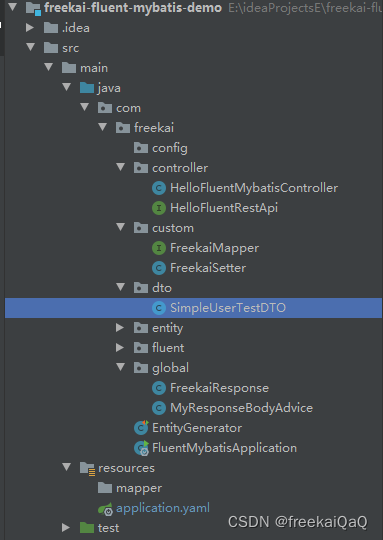
spring: datasource: url: jdbc:mysql://localhost:3306/test?useUnicode=true&characterEncoding=UTF-8&useSSL=false&autoReconnect=true&serverTimezone=Asia/Shanghai username: root password: root driver-class-name: com.mysql.jdbc.Driver server: port: 8001mybatis: configuration: # 配置打印sql语句到控制台 log-impl: org.apache.ibatis.logging.stdout.StdOutImpl项目的目录结构如下
也是可以通过 代码生成 工具,完成dao、entity等类的生成。首先得自己先在库里把表建好。
package com.freekai; import cn.org.atool.generator.FileGenerator;import cn.org.atool.generator.annotation.Relation;import cn.org.atool.generator.annotation.RelationType;import cn.org.atool.generator.annotation.Table;import cn.org.atool.generator.annotation.Tables;import com.freekai.custom.FreekaiMapper;import org.junit.Test; public class EntityGenerator { //数据源url static final String url = "jdbc:mysql://localhost:3306/test?useUnicode=true&characterEncoding=UTF-8&useSSL=false&autoReconnect=true&serverTimezone=Asia/Shanghai"; //数据库用户名 static final String username = "root"; //数据库密码 static final String password = "root"; @Test public void generate() throws Exception { //引用配置类,build方法允许有多个配置类 FileGenerator.build(Empty.class); } @Tables( //设置数据库连接信息 url = url,username = username,password = password, driver = "com.mysql.jdbc.Driver", //设置entity类生成src目录,相对于user.dir srcDir = "src/main/java", //设置entity类的package值 basePack = "com.freekai.fluent", //设置dao接口和实现的src目录,相对于user.dir daoDir = "src/main/java", //设置哪些表要生成Entity文件 tables = {@Table(value = {"user_test_address","user_test"}, logicDeleted = "is_delete", superMapper = FreekaiMapper.class)}, relations = { @Relation(method = "findAddressV2", source = "user_test", target = "user_test_address", type = RelationType.OneWay_0_1 , where = "id=user_test_id"), @Relation(method = "findUserTestV2", source = "user_test_address", target = "user_test", type = RelationType.OneWay_0_1) } ) static class Empty{ //类名随便取,只是配置定义的一个载体 } }
上面的tables中 user_test_address user_test两张表配置了 1对1的映射。和hibernate中的@OneToOne含义一致。
另外也指定了逻辑删除的字段是is_delete。
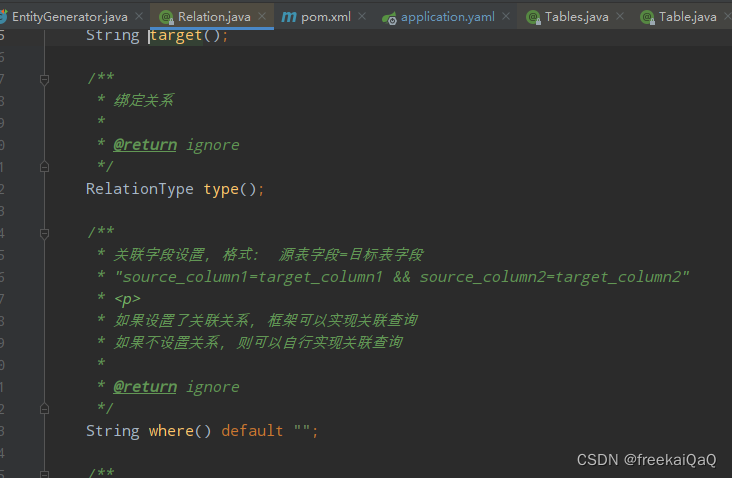
细心的朋友会发现还有一个@Relation的配置。 method: findAddressV2即相当于会在生成的实体类中生成一个findAddressV2这个方法,这个方法的返回值是对应的关联表的实体类。where="id=user_test_id" 和source及target组合起来后,相当于 user_test.id = user_test_address.user_test_id (即在user_test_address表中有一个user_test_id字段,存储的是user_test表的id值),源码中也有注释。
另一个@Relation同理,反着配置一下就可以了。 执行上述代码中的generate()方法,可以发现目录下有生成的文件。
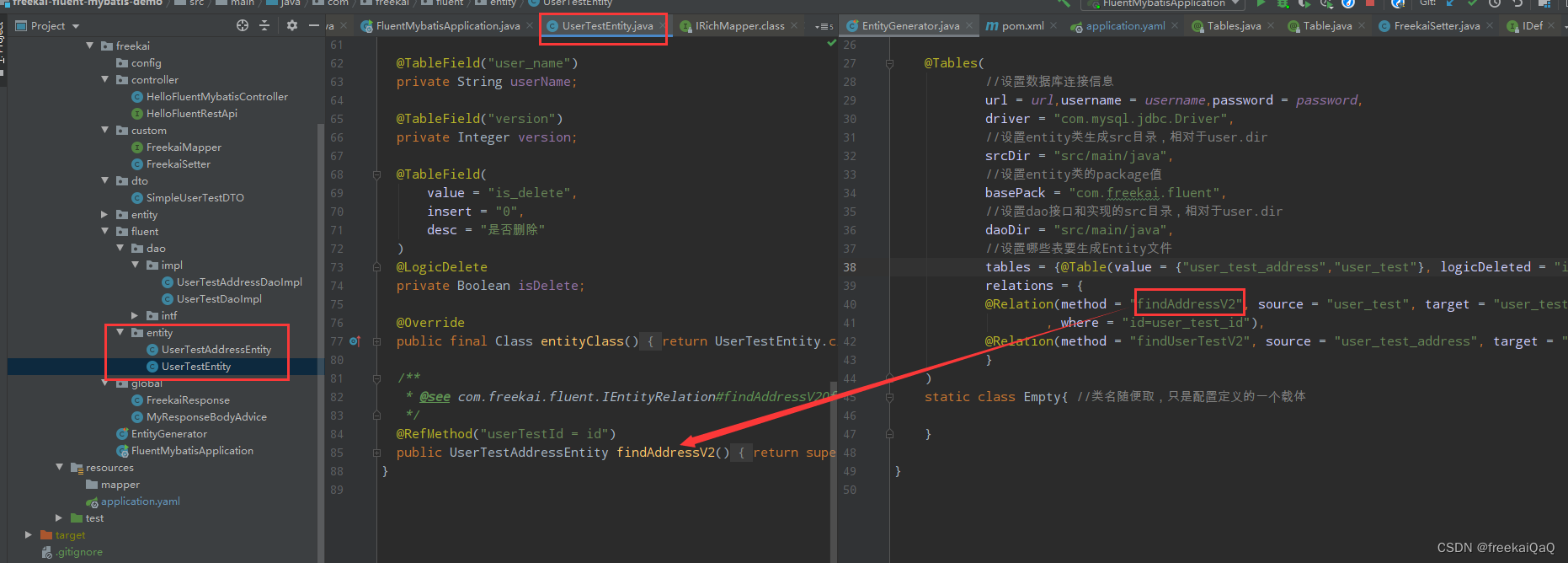
UserTestEntity.java
package com.freekai.fluent.entity; import cn.org.atool.fluent.mybatis.annotation.FluentMybatis;import cn.org.atool.fluent.mybatis.annotation.LogicDelete;import cn.org.atool.fluent.mybatis.annotation.RefMethod;import cn.org.atool.fluent.mybatis.annotation.TableField;import cn.org.atool.fluent.mybatis.annotation.TableId;import cn.org.atool.fluent.mybatis.base.RichEntity;import com.freekai.custom.FreekaiMapper;import java.util.Date;import lombok.AllArgsConstructor;import lombok.Data;import lombok.EqualsAndHashCode;import lombok.NoArgsConstructor;import lombok.experimental.Accessors; /** * UserTestEntity: 数据映射实体定义 * * @author Powered By Fluent Mybatis */@SuppressWarnings({"rawtypes", "unchecked"})@Data@Accessors( chain = true)@EqualsAndHashCode( callSuper = false)@AllArgsConstructor@NoArgsConstructor@FluentMybatis( table = "user_test", schema = "test", superMapper = FreekaiMapper.class, desc = "userTest表的简单描述")public class UserTestEntity extends RichEntity { private static final long serialVersionUID = 1L; @TableId( value = "id", auto = false ) private Integer id; @TableField("address_id") private Integer addressId; @TableField("age") private Integer age; @TableField("create_time") private Date createTime; @TableField("tel") private String tel; @TableField("update_time") private Date updateTime; @TableField("user_name") private String userName; @TableField("version") private Integer version; @TableField( value = "is_delete", insert = "0", desc = "是否删除" ) @LogicDelete private Boolean isDelete; @Override public final Class entityClass() { return UserTestEntity.class; } /** * @see com.freekai.fluent.IEntityRelation#findAddressV2OfUserTestEntity(java.util.List) */ @RefMethod("userTestId = id") public UserTestAddressEntity findAddressV2() { return super.invoke("findAddressV2", true); }}userTestAddress.java
package com.freekai.fluent.entity; import cn.org.atool.fluent.mybatis.annotation.FluentMybatis;import cn.org.atool.fluent.mybatis.annotation.RefMethod;import cn.org.atool.fluent.mybatis.annotation.TableField;import cn.org.atool.fluent.mybatis.annotation.TableId;import cn.org.atool.fluent.mybatis.base.RichEntity;import com.freekai.custom.FreekaiMapper;import lombok.AllArgsConstructor;import lombok.Data;import lombok.EqualsAndHashCode;import lombok.NoArgsConstructor;import lombok.experimental.Accessors; /** * UserTestAddressEntity: 数据映射实体定义 * * @author Powered By Fluent Mybatis */@SuppressWarnings({"rawtypes", "unchecked"})@Data@Accessors( chain = true)@EqualsAndHashCode( callSuper = false)@AllArgsConstructor@NoArgsConstructor@FluentMybatis( table = "user_test_address", schema = "test", superMapper = FreekaiMapper.class)public class UserTestAddressEntity extends RichEntity { private static final long serialVersionUID = 1L; @TableId( value = "id", auto = false ) private Integer id; @TableField("address") private String address; @TableField("user_test_id") private Integer userTestId; @Override public final Class entityClass() { return UserTestAddressEntity.class; } /** * @see com.freekai.fluent.IEntityRelation#findUserTestV2OfUserTestAddressEntity(UserTestAddressEntity) */ @RefMethod public UserTestEntity findUserTestV2() { return super.invoke("findUserTestV2", true); }}思考有个问题,如何像JPA一样根据主键+是否删除这个字段查询呢? 实现是比较简单,那么是不是每个 实体类 都需要再写一遍很类似的代码呢? ans:不需要。见下方
superMapper指定了自定义的一个类FreekaiMapper,这个类里,我自定义了一个根据主键+是否删除这个字段查询的方法。 相当于Jpa中 findByIdAndIsDelete(id, isDelete)..., FreekaiMapper.class内容如下
package com.freekai.custom; import cn.org.atool.fluent.mybatis.If;import cn.org.atool.fluent.mybatis.base.IEntity;import cn.org.atool.fluent.mybatis.base.crud.IQuery;import cn.org.atool.fluent.mybatis.base.crud.IWrapper;import cn.org.atool.fluent.mybatis.base.entity.IMapping;import cn.org.atool.fluent.mybatis.base.free.FreeQuery;import cn.org.atool.fluent.mybatis.base.mapper.IEntityMapper;import cn.org.atool.fluent.mybatis.base.mapper.IMapper;import cn.org.atool.fluent.mybatis.base.mapper.IRichMapper;import cn.org.atool.fluent.mybatis.base.model.SqlOp;import cn.org.atool.fluent.mybatis.base.provider.SqlKitFactory;import cn.org.atool.fluent.mybatis.exception.FluentMybatisException;import cn.org.atool.fluent.mybatis.segment.WhereBase;import cn.org.atool.fluent.mybatis.segment.model.WrapperData;import org.apache.ibatis.annotations.Mapper;import org.springframework.stereotype.Component;import org.springframework.util.StringUtils; import java.util.List; /** * 自定义mapper,在代码生成时 配置一个supperMapper * 或者是在entity实体类上的@FluentMybatis注解中配置superMapper值 * @FluentMybatis( * table = "user_test", * schema = "test", * superMapper = FreekaiMapper.class * ) * * * @param <E> */public interface FreekaiMapper<E extends IEntity> extends IEntityMapper<E>, IRichMapper<E> { default E findByIdAndIsDelete(Object id, Boolean isDelete) { final IMapping mapping = this.mapping(); IQuery query = mapping.emptyQuery(); String primary = mapping.primaryId(true); // 逻辑删除的字段 final String loginDeleteColumn = mapping.logicDeleteColumn(); final WhereBase apply = query.where().apply(primary, SqlOp.EQ, new Object[]{id}); if(!StringUtils.isEmpty(loginDeleteColumn)){ apply.and.apply(loginDeleteColumn, SqlOp.EQ, isDelete); } final List<E> list = this.listEntity(query); if (If.isEmpty(list)) { return null; } else if (list.size() == 1) { return list.get(0); } else { throw new FluentMybatisException("Expected one result (or null) to be returned, but found " + list.size() + " results."); } }}
其中fluent-mybatis语法可以去官方查看对应的文档。下面一个controller是自己随便写的一些,完整的项目代码在github上。 https://github.com/freekai777/freekai-fluent-mybatis-demohttps://github.com/freekai777/freekai-fluent-mybatis-demo
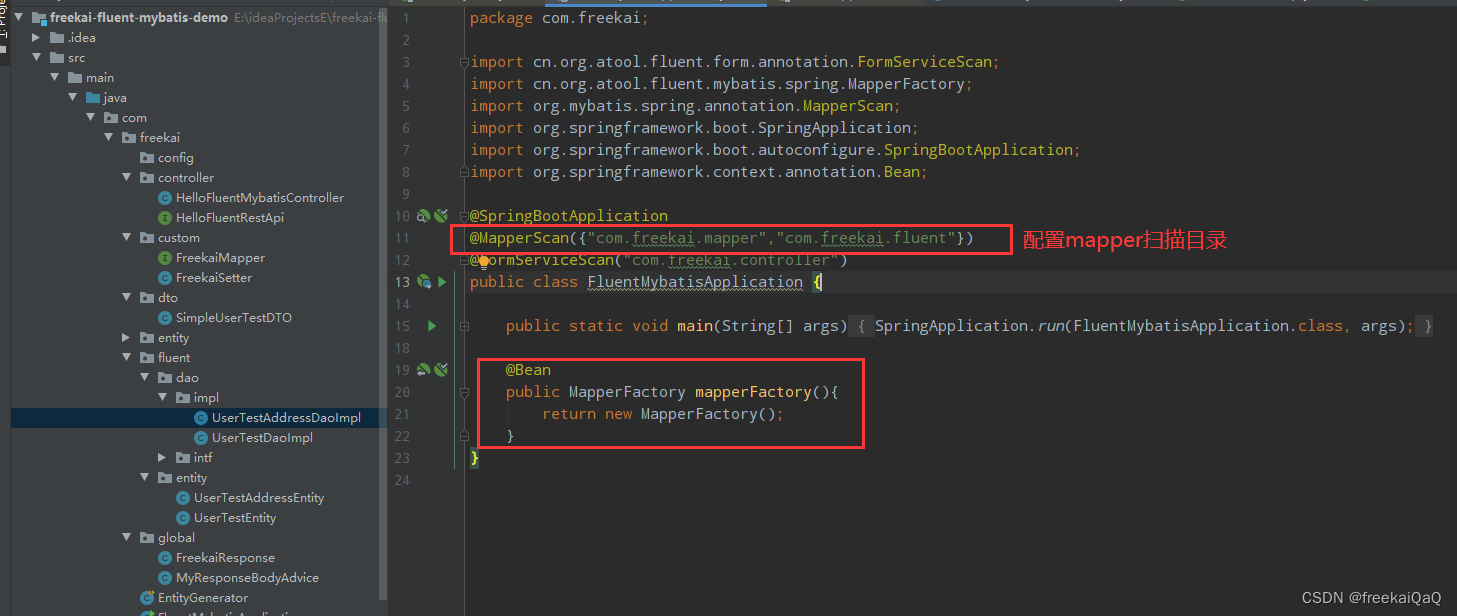
package com.freekai.controller; import cn.org.atool.fluent.mybatis.base.free.FreeQuery;import cn.org.atool.fluent.mybatis.base.model.FieldMapping;import cn.org.atool.fluent.mybatis.model.StdPagedList;import com.freekai.dto.SimpleUserTestDTO;import com.freekai.entity.HelloFluentEntity;//import com.freekai.mapper.HelloFluentMapper;import com.freekai.fluent.entity.UserTestEntity;import com.freekai.fluent.mapper.UserTestMapper;import com.freekai.fluent.wrapper.UserTestQuery;import com.freekai.mapper.HelloFluentMapper;import org.springframework.beans.factory.annotation.Autowired;import org.springframework.util.StringUtils;import org.springframework.web.bind.annotation.*; import java.util.HashMap;import java.util.List;import java.util.Map;import java.util.Random; @RestControllerpublic class HelloFluentMybatisController { @Autowired private UserTestMapper userTestMapper; @PostMapping("/addHello") public int addHello(){ UserTestEntity entity = new UserTestEntity(); entity.setId(1000*new Random().nextInt(10) + 1); final int insert = userTestMapper.insertWithPk(entity); return insert; } @PutMapping("/updateUser") public int updateUser(@RequestParam String id){ final UserTestEntity byIdAndIsDelete = userTestMapper.findByIdAndIsDelete(id, false); return 1; } @GetMapping("/user") public UserTestEntity get(@RequestParam Integer userId ){ final UserTestEntity byId = userTestMapper.findById(userId); return byId; } /** * 聚合的语法 * @return */ @GetMapping("/agg") public List<Map<String,Object>> aggregation(){ final List<Map<String, Object>> maps = userTestMapper.listMaps(userTestMapper.query().select.userName("userNameAlias") .count("cc").end().groupBy.userName().end().orderBy.desc("cc").end()); return maps; } /** * 分页查询 * @param userName * @param page * @param size * @return */ @GetMapping("/users") public StdPagedList<UserTestEntity> list(@RequestParam(required = false, value = "userName") String userName, @RequestParam(value = "page", defaultValue = "1",required = false) Integer page, @RequestParam(value = "size", defaultValue = "10",required = false) Integer size){ final StdPagedList<UserTestEntity> res = userTestMapper.stdPagedEntity(new UserTestQuery().where.userName() .like(userName, !StringUtils.isEmpty(userName)).end().limit((page - 1) * size, size)); return res; } /** * 分页且映射成自定义实体类的查询 * * 查询出来的 字段取的别名一定要求在 映射的实体类中存在。否则会报错!! * */ @GetMapping("/users2") public StdPagedList<SimpleUserTestDTO> listWithDtos(@RequestParam(required = false, value = "userName") String userName, @RequestParam(value = "page", defaultValue = "1",required = false) Integer page, @RequestParam(value = "size", defaultValue = "10",required = false) Integer size){ final StdPagedList<SimpleUserTestDTO> res = userTestMapper.stdPagedPoJo(SimpleUserTestDTO.class, new UserTestQuery() .select.id("idNew").createTime("createTime").end().where.userName() .like(userName, !StringUtils.isEmpty(userName)).end().limit((page - 1) * size, size)); return res; } /** * 自定义sql查询 * 通过占位符的形式 username * @return */ @GetMapping("/custom_sql") public List<Map<String,Object>> customQuery(@RequestParam String userName){ Map<String,String> param = new HashMap<>(16); param.put("userNN", userName + "%"); final FreeQuery freeQuery = new FreeQuery(null).customizedByPlaceholder(" select * from user_test t where t.user_name like #{userNN} ", param); final List<Map<String, Object>> maps = userTestMapper.listMaps(freeQuery); return maps; }}一键获取完整项目代码java运行 另外也有一种,甚至连实现都不用写的,直接用Jpa的写法。需要在类上加注解 @FormService(table = "user_test") ,然后在启动类上配置扫描路径 @SpringBootApplication @MapperScan({"com.freekai.mapper","com.freekai.fluent"}) @FormServiceScan("com.freekai.controller") public class FluentMybatisApplication {...} @RestController@FormService(table = "user_test")public interface HelloFluentRestApi { @GetMapping("/findByUserName") UserTestEntity findByUserName(@RequestParam("userName") @Entry(value = "userName") String userName);}一键获取完整项目代码java运行 通过postMan调用,发现也可以出现正确的结果。
 技术文档
技术文档
 推荐好文
推荐好文






 155-2731-8020