




软件

产品


在计算几何中,Bentley-Ottmann 算法是一种扫描线算法,用于列出一组线段中的所有交叉点,即它找到线段的交点(或简称为交点)。它扩展了 Shamos–Hoey 算法。用于测试一组线段是否有任何交叉点。对于包含的输入n 个线段与,k 个交叉点(或交叉路口),Bentley–Ottmann 算法需要时间 O( (N+k)logN )
给定一组 N 条线段(2*N 点),你需要找到这些线段之间的所有交点。
也许,您首先想到的是一种天真的方法来检查所有线段对是否相交。但是你知道这不是一个好方法,因为如果我们的交叉点较少,它会包含不必要的计算。其次,它会以未排序的顺序给出交叉点。所以,我们需要一些替代方法来解决这个问题。
我们可以使用线扫描技术解决这个问题。但是在解决这个问题之前,首先让我们只考虑水平和垂直线段。
问题:给定N条水平线段和垂直线段,我们需要找到水平线段和垂直线段的所有交点。在这里,我们不会考虑重合的端点相交。
方法:继续我们的事件和活动集的概念,让我们首先为这个问题定义它们。在这里,我们将考虑三种类型的事件:水平线段的开始、水平线段的结束和垂直线段。我们的活动集包含所有被扫描线切割的水平线段(按 y 坐标排序)。
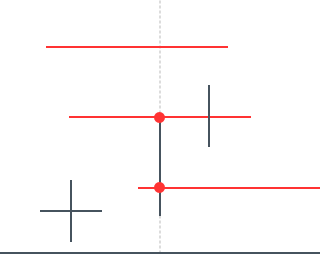
虚线是扫描线,黑线是给定的水平线和垂直线,红线是任意时刻与扫描线相交的水平线。
我们的算法如下:
1. 当我们击中水平线段的起点时,我们将线(在我们的实现中,我们将插入起点)插入到我们的集合中。
2. 当我们击中水平线段的终点时,我们从集合中移除线段(实现中线段的起点)。
3. 当我们碰到一条垂直线时,我们检查集合中位于垂直线段起始和结束 y 坐标之间的所有线段,即,如果垂直线段由 (x1,y1) 和 (x1) 表示,y2), 我们检查位于 (y1,y2) 范围内的水平线段。
这就完成了我们的算法。那么,让我们跳到实现部分:
#define x second#define y firsttypedef pair<int,int >point;struct event { point p1,p2; int type; event() {}; event(point p1,point p2, int type) : p1(p1), p2(p2),type(type) {}; //initialization of event};int n,e;event events[MAX];bool compare(event a, event b) { return a.p1.x<b.p1.x; }set<point >s;void hv_intersection(){ for (int i=0;i<e;++i) { event c = events[i]; if (c.type==0) s.insert(c.p1);//insert starting point of line segment into set else if (c.type==1) s.erase(c.p2);//remove starting point of line segment from set, equivalent to removing line segment else { for (typeof(s.begin()) it=s.lower_bound(make_pair(c.p1.y,-1));it!=s.end() && it->y<=c.p2.y; it++) // Range search printf("%d, %d\n", events[i].p1.x, it->y);//intersections } }}int main () { scanf("%d", &n); int p1x,p1y,p2x,p2y; for (int i=0;i<n;++i) { scanf("%d %d %d %d", &p1x, &p1y,&p2x, &p2y); if(p1x==p2x) //if vertical line, one event with type=2 { events[e++]=event(make_pair(p1y,p1x),make_pair(p2y,p2x),2); } else //if horizontal line, two events one for starting point and one for ending point { //store both starting points and ending points events[e++]=event(make_pair(p1y,p1x),make_pair(p2y,p2x),0); //store both ending and starting points, note the order in the second, this is because we sort on p1, so ending points first, then we remove a line when we hit its ending point , so we need its starting point for removal of line events[e++]=event(make_pair(p2y,p2x),make_pair(p1y,p1x),1); } } sort(events, events+e,compare);//on x coordinate hv_intersection(); return 0;} 复杂度分析:所有对事件的操作(insert,erase, lower_bound)都需要O(log(N))
时间,内循环运行 k 次,其中 k 是交叉点的数量。因此,上述算法的复杂度为O(Nlog(N)+k)
所以,下一个想到的问题是如果 k 是O(N*2),所以在那种情况下我们的算法运行缓慢。这是对的,但想想如果我们有路口,然后我们得到相当大的加速。其次,如果我们只需要交叉点的数量而不是交叉点本身会怎么样。然后我们可以找到交叉点的数量使用二叉树结构的时间(通过将子树的大小存储在子树的根中)。
让我们回到我们的问题,线条不一定是垂直或水平的。在那种情况下该怎么办?
A: 首先,让我们列出算法中的假设:
1.没有垂直线段。
2. 没有两条线段在它们的端点处相交。
3. 没有三个(或更多)路段有共同的交叉点。
4.线段的所有端点和所有交点具有不同的x坐标。
5. 没有两个段重叠。
B :主要相交性判别原理:
1. 两条线相交,它们必须彼此相邻。因此,我们将只检查相邻线是否相交。
2. 当两条线段相交时,它们改变位置,即相交前在下方的线在上方,另一条线在下方。
C: 在开始算法之前,首先让我们定义事件和活动集。
扫描线算法的Events
事件:线段的端点、交点。(我们会在找到它们时插入交点)。在这里,我们将使用优先级队列作为我们的数据结构,因为由于交叉点的动态插入和删除,预排序将不起作用。让我们用 PQ 表示优先级队列
扫描线算法的Active Set
在任何时候,活动集都包含被扫描线切割的线段,按 y 坐标排序。让我们用 SL 表示这个活动集。伪代码:
Initialize PQ = all segment endpoints; Initialize SL to be empty; Initialize output intersection list IL to be empty; While (PQ is nonempty) { Let E = the next event from PQ; If (E is a left endpoint) { Let segE = segment of E; Add segE to SL; Let segA = the segment Above segE in SL; Let segB = the segment Below segE in SL; If (I = Intersect( segB with segA) exists) Delete I from PQ; If (I = Intersect( segE with segA) exists) Insert I into PQ; If (I = Intersect( segE with segB) exists) Insert I into PQ; } Else If (E is a right endpoint) { Let segE = segment of E; Let segA = the segment Above segE in SL; Let segB = the segment Below segE in SL; Delete segE from SL; If (I = Intersect( segA with segB) exists) Insert I into PQ; } Else { // E is an intersection event Add intersect point of E to the output list IL; Let segE1 above segE2 be intersecting segments of E in SL; Swap their positions so that segE2 is now above segE1; Let segA = the segment above segE2 in SL; Let segB = the segment below segE1 in SL; If (I = Intersect( segE1 with segA) exists) Delete I from PQ; If (I = Intersect( segE2 with segB) exists) Delete I from PQ; If (I = Intersect(segE2 with segA) exists) Insert I into PQ; If (I = Intersect(segE1 with segB) exists) Insert I into PQ; } remove E from PQ; } return IL;}那是 Bentley Ottmann 算法,用于在给定 N 条线段时找到所有交叉点。让我们看一下图像以更好地理解它。
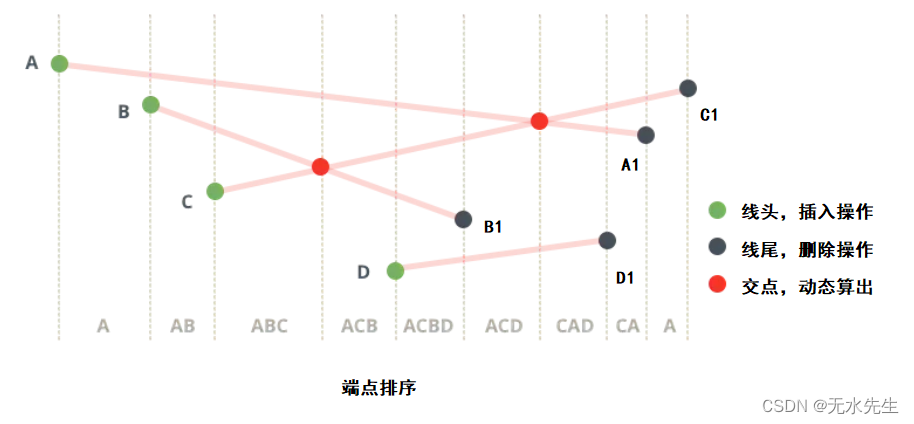
算法详解:
1)输入线段:( P(x,y),P1(x,y))循环输入全部线段用PP1表示。
2)对所有的线段端点(包括P和P1)按照x坐标排序,上图排序结果是:
PQ = 【 A,B,C,D,B1,D1,A1,C1】
3)我们提取 PQ 中的最小值并将其作为我们的事件。所以,我们知道这个事件可能是左端点、右端点或交点。如图:扫描线对PQ扫描,扫到A
 A进入队列,(A是第一个点)
List = 【A】 表示唯一线段是A为起始点。
List = 【A,B】
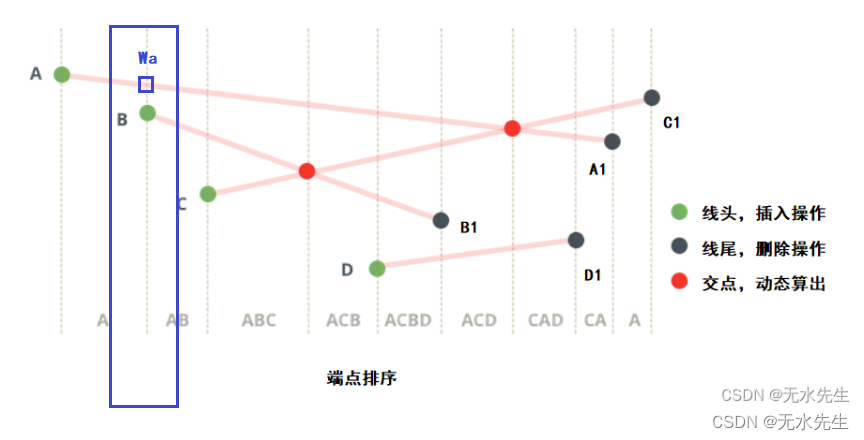
List = 【A,B,C】
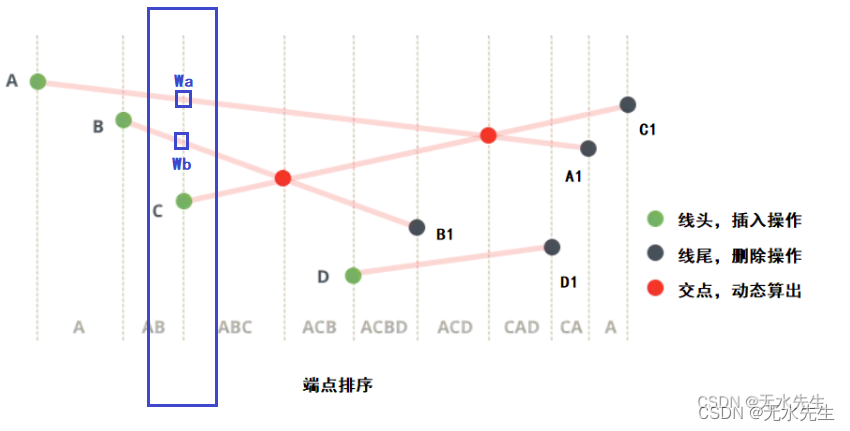
所以: List = 【A,C,B,D】
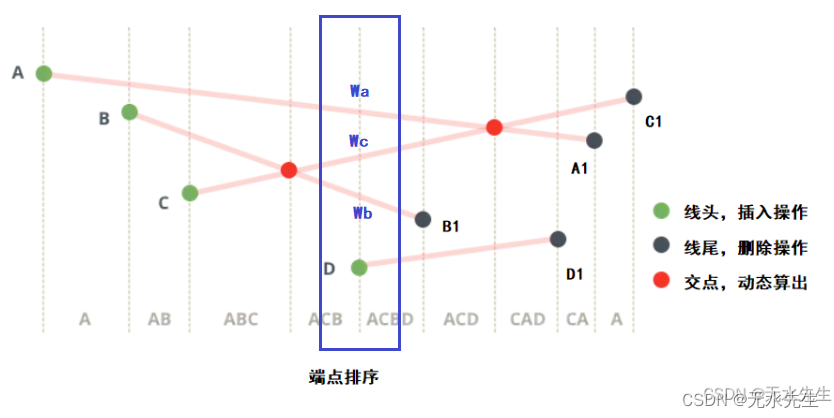
可以观察到,线序从【A,B,C】跳转到 List = 【A,C,B,D】 其中B和C产生一个逆序,因此,B和C有一个交点。(求出该交点保存)
List = 【A,C, D】
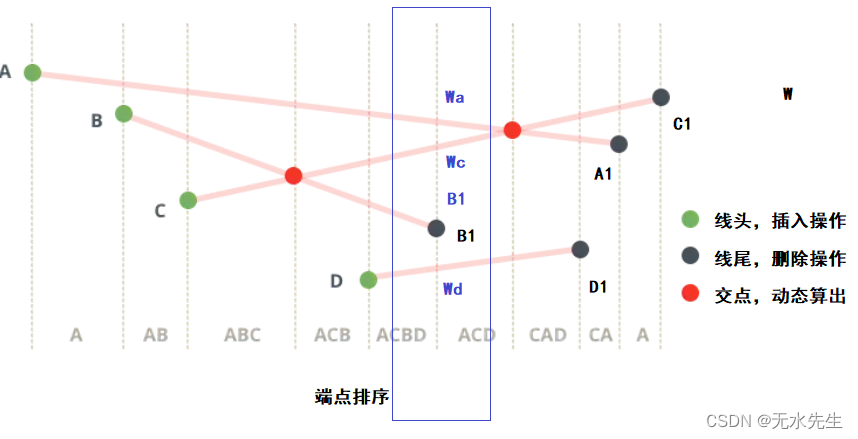
List = 【C,A】这里产生一个逆序,所以A和C两个线段必然相交,求出交点并保存。
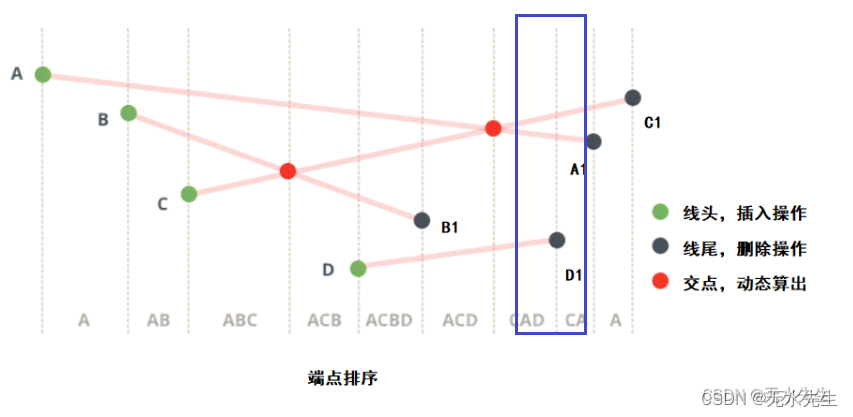
List = 【C 】 。
算法结束。
# lsi.py# Implementation of the Bentley-Ottmann algorithm, described in deBerg et al, ch. 2.# See README for more information.# Author: Sam Lichtenberg# Email: splichte@princeton.edu# Date: 09/02/2013 from Q import Qfrom T import Tfrom helper import * # "close enough" for floating pointev = 0.00000001 # how much lower to get the x of a segment, to determine which of a set of segments is the farthest right/leftlower_check = 100 # gets the point on a segment at a lower y value.def getNextPoint(p, seg, y_lower): p1 = seg[0] p2 = seg[1] if (p1[0]-p2[0])==0: return (p[0]+10, p[1]) slope = float(p1[1]-p2[1])/(p1[0]-p2[0]) if slope==0: return (p1[0], p[1]-y_lower) y = p[1]-y_lower x = p1[0]-(p1[1]-y)/slope return (x, y) """for each event point: U_p = segments that have p as an upper endpoint C_p = segments that contain p L_p = segments that have p as a lower endpoint"""def handle_event_point(p, segs, q, t, intersections): rightmost = (float("-inf"), 0) rightmost_seg = None leftmost = (float("inf"), 0) leftmost_seg = None U_p = segs (C_p, L_p) = t.contain_p(p) merge_all = U_p+C_p+L_p if len(merge_all) > 1: intersections[p] = [] for s in merge_all: intersections[p].append(s) merge_CL = C_p+L_p merge_UC = U_p+C_p for s in merge_CL: # deletes at a point slightly above (to break ties) - where seg is located in tree # above intersection point t.delete(p, s) # put segments into T based on where they are at y-val just below p[1] for s in merge_UC: n = getNextPoint(p, s, lower_check) if n[0] > rightmost[0]: rightmost = n rightmost_seg = s if n[0] < leftmost[0]: leftmost = n leftmost_seg = s t.insert(p, s) # means only L_p -> check newly-neighbored segments if len(merge_UC) == 0: neighbors = (t.get_left_neighbor(p), t.get_right_neighbor(p)) if neighbors[0] and neighbors[1]: find_new_event(neighbors[0].value, neighbors[1].value, p, q) # of newly inserted pts, find possible intersections to left and right else: left_neighbor = t.get_left_neighbor(p) if left_neighbor: find_new_event(left_neighbor.value, leftmost_seg, p, q) right_neighbor = t.get_right_neighbor(p) if right_neighbor: find_new_event(right_neighbor.value, rightmost_seg, p, q) def find_new_event(s1, s2, p, q): i = intersect(s1, s2) if i: if compare_by_y(i, p) == 1: if not q.find(i): q.insert(i, []) # segment is in ((x, y), (x, y)) form# first pt in a segment should have higher y-val - this is handled in functiondef intersection(S): s0 = S[0] if s0[1][1] > s0[0][1]: s0 = (s0[1], s0[0]) q = Q(s0[0], [s0]) q.insert(s0[1], []) intersections = {} for s in S[1:]: if s[1][1] > s[0][1]: s = (s[1], s[0]) q.insert(s[0], [s]) q.insert(s[1], []) t = T() while q.key: p, segs = q.get_and_del_min() handle_event_point(p, segs, q, t, intersections) return intersections# Test.py# Test file for lsi.# Author: Sam Lichtenberg# Email: splichte@princeton.edu# Date: 09/02/2013 from lsi import intersectionimport randomimport time, sysfrom helper import * ev = 0.00000001 def scale(i): return float(i) use_file = Nonetry: use_file = sys.argv[2]except: pass if not use_file: S = [] for i in range(int(sys.argv[1])): p1 = (scale(random.randint(0, 1000)), scale(random.randint(0, 1000))) p2 = (scale(random.randint(0, 1000)), scale(random.randint(0, 1000))) s = (p1, p2) S.append(s) f = open('input', 'w') f.write(str(S)) f.close() else: f = open(sys.argv[2], 'r') S = eval(f.read()) intersections = []seen = []vs = Falsehs = Falsees = Falsenow = time.time()for seg1 in S: if approx_equal(seg1[0][0], seg1[1][0], ev): print 'VERTICAL SEG' print '' print '' vs = True if approx_equal(seg1[0][1], seg1[1][1], ev): print 'HORIZONTAL SEG' print '' print '' hs = True for seg2 in S: if seg1 is not seg2 and segs_equal(seg1, seg2): print 'EQUAL SEGS' print '' print '' es = True if seg1 is not seg2 and (seg2, seg1) not in seen: i = intersect(seg1, seg2) if i: intersections.append((i, [seg1, seg2])) # xpts = [seg1[0][0], seg1[1][0], seg2[0][0], seg2[1][0]] # xpts = sorted(xpts) # if (i[0] <= xpts[2] and i[0] >= xpts[1]: # intersections.append((i, [seg1, seg2])) seen.append((seg1, seg2))later = time.time()n2time = later-nowprint "Line sweep results:"now = time.time()lsinters = intersection(S)inters = []for k, v in lsinters.iteritems(): #print '{0}: {1}'.format(k, v) inters.append(k)# inters.append(v)later = time.time()print 'TIME ELAPSEhttps://www.gofarlic.com {0}'.format(later-now)print "N^2 comparison results:"pts_seen = []highestseen = 0for i in intersections: seen_already = False seen = 0 for p in pts_seen: if approx_equal(i[0][0], p[0], ev) and approx_equal(i[0][1], p[1], ev): seen += 1 seen_already = True if seen > highestseen: highestseen = seen if not seen_already: pts_seen.append(i[0]) in_k = False for k in inters: if approx_equal(k[0], i[0][0], ev) and approx_equal(k[1], i[0][1], ev): in_k = True if in_k == False: print 'Not in K: {0}: {1}'.format(i[0], i[1])# print iprint highestseenprint 'TIME ELAPSEhttps://www.gofarlic.com {0}'.format(n2time)#print 'Missing from line sweep but in N^2:'#for i in seen:# matched = Falseprint len(lsinters)print len(pts_seen)if len(lsinters) != len(pts_seen): print 'uh oh!'for more information. Usage: from lsi import intersection # S is a list of tuples of the form: ((x,y), (x,y))i = intersection(S) This function returns a dictionary of intersection points (keys) and a list of their associated segments (values). Currently, this implementation does not handle horizontal/vertical line segments. This will be changed shortly! A test file is available. It compares the running time of the algorithm to that of a brute-force O(N^2) comparison. It also generates a specified number of random input segments--you can set the precision and range by editing the file. Email at: splichte@princeton.edupython -m pip install --upgrade bentley_ottmann1、从 GitHub 存储库下载最新版本
git clone https://github.com/lycantropos/bentley_ottmann.gitcd bentley_ottmann2、安装依赖包
python -m pip install -r requirements.txt3、正式安装
python setup.py installUsageWith segments >>> from ground.base import get_context>>> context = get_context()>>> Point, Segment = context.point_cls, context.segment_cls>>> unit_segments = [Segment(Point(0, 0), Point(1, 0)), ... Segment(Point(0, 0), Point(0, 1))]we can check if they intersect >>> from bentley_ottmann.planar import segments_intersect>>> segments_intersect(unit_segments)TrueWith contours >>> Contour = context.contour_cls>>> triangle = Contour([Point(0, 0), Point(1, 0), Point(0, 1)])>>> degenerate_triangle = Contour([Point(0, 0), Point(2, 0), Point(1, 0)])we can check if they are self-intersecting or not >>> from bentley_ottmann.planar import contour_self_intersects>>> contour_self_intersects(triangle)False>>> contour_self_intersects(degenerate_triangle)True
免责声明:本文系网络转载或改编,未找到原创作者,版权归原作者所有。如涉及版权,请联系删
 技术文档
技术文档
 推荐好文
推荐好文






 155-2731-8020