




软件

产品


摘要:Pietra-Ricci指数通常用于经济和社会科学中作为不平等性的衡量指标。在本函授中,该指数被调整用于协作频谱感知场景,得到了Pietra-Ricci指数检测器(PRIDe)。PRIDe应用该指数区分接收信号样本协方差矩阵在有主要感知信号和无主要感知信号情况下的形状。结果显示,PRIDe非常简单,对时变噪声和接收信号功率具有鲁棒性,具有恒定虚警率特性,并且在许多情况下胜过最先进的检测器。
无线电频谱(RF)目前因大量无线通信系统的运行而拥挤,并且由于采用了固定分配政策,主用户(PU)网络被授予对特定RF频段的独占使用权。这种情况随着物联网(IoT)和第五代(5G)无线通信网络的大规模部署而恶化,主要是由于预期的终端数量增加和对更高带宽的需求。
认知无线电(CR)概念已经成为RF频谱短缺的潜在解决方案,通过探索频谱在时间和空间上的多变性 [1],[2]。CR网络可以采用动态频谱访问政策,其中认知次级用户(SU)终端可以机会性地使用未被占用的频段。为了检测感兴趣的频段中主用户信号的存在,SU应用一种称为频谱感知的过程 [2],[3],可能由RF频谱占用数据库 [4] 协助。
频谱感知可以由每个SU独立进行,也可以借助合作进行。前者面临一些问题,例如多径衰落、阴影和隐藏终端等,这些问题会降低主用户信号的检测能力 [2]。合作可以通过不同位置的SU之间的空间多样性来提高频谱占用的决策准确性。
在这里考虑的分布式合作频谱感知(CSS)中,通过数据融合,接收信号的样本或经由此得出的量被传输到融合中心(FC),在那里形成一个检验统计量并作出全局决策。这个决策通知给SU,如果频段为空闲,它们将通过某些多址访问协议竞争使用该频段。
详细文章见第4部分。
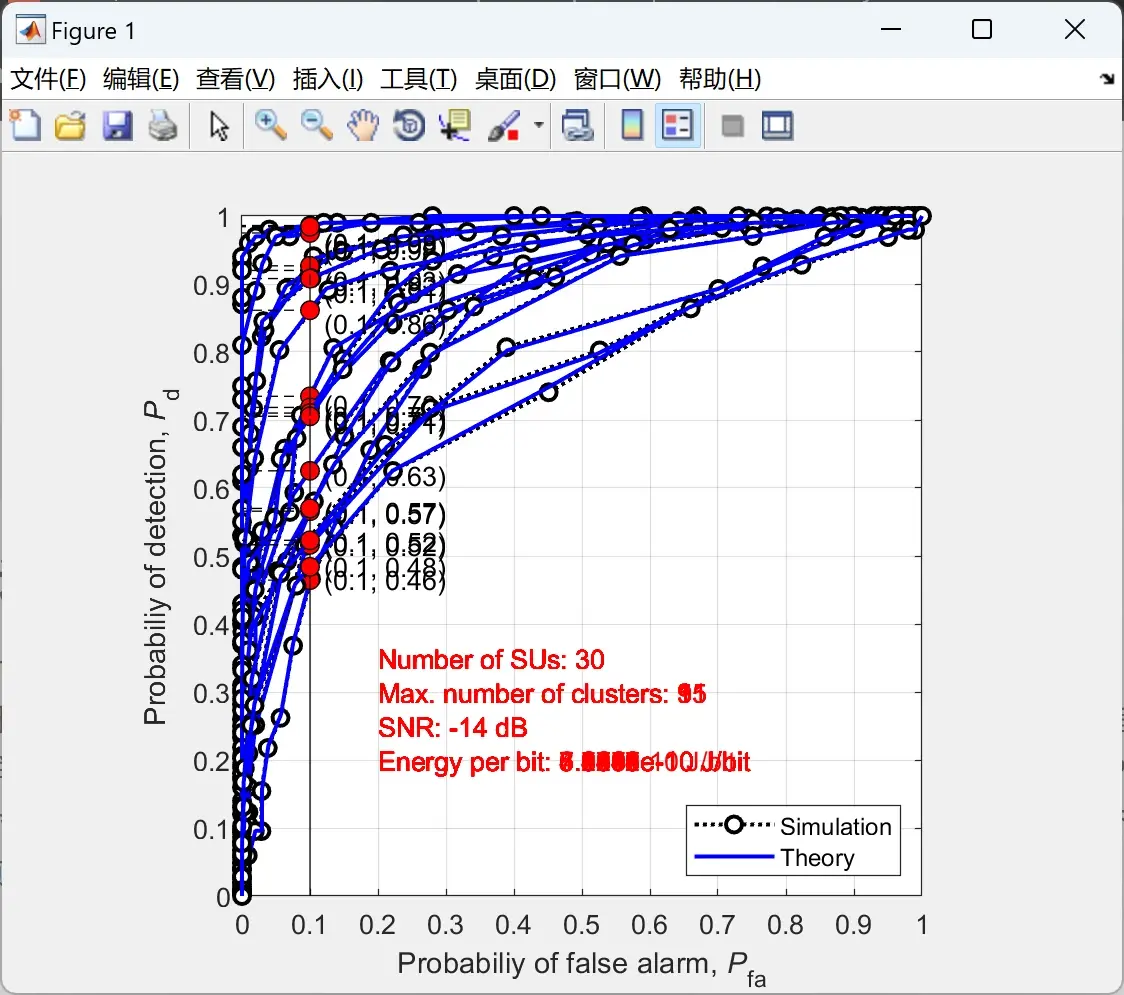
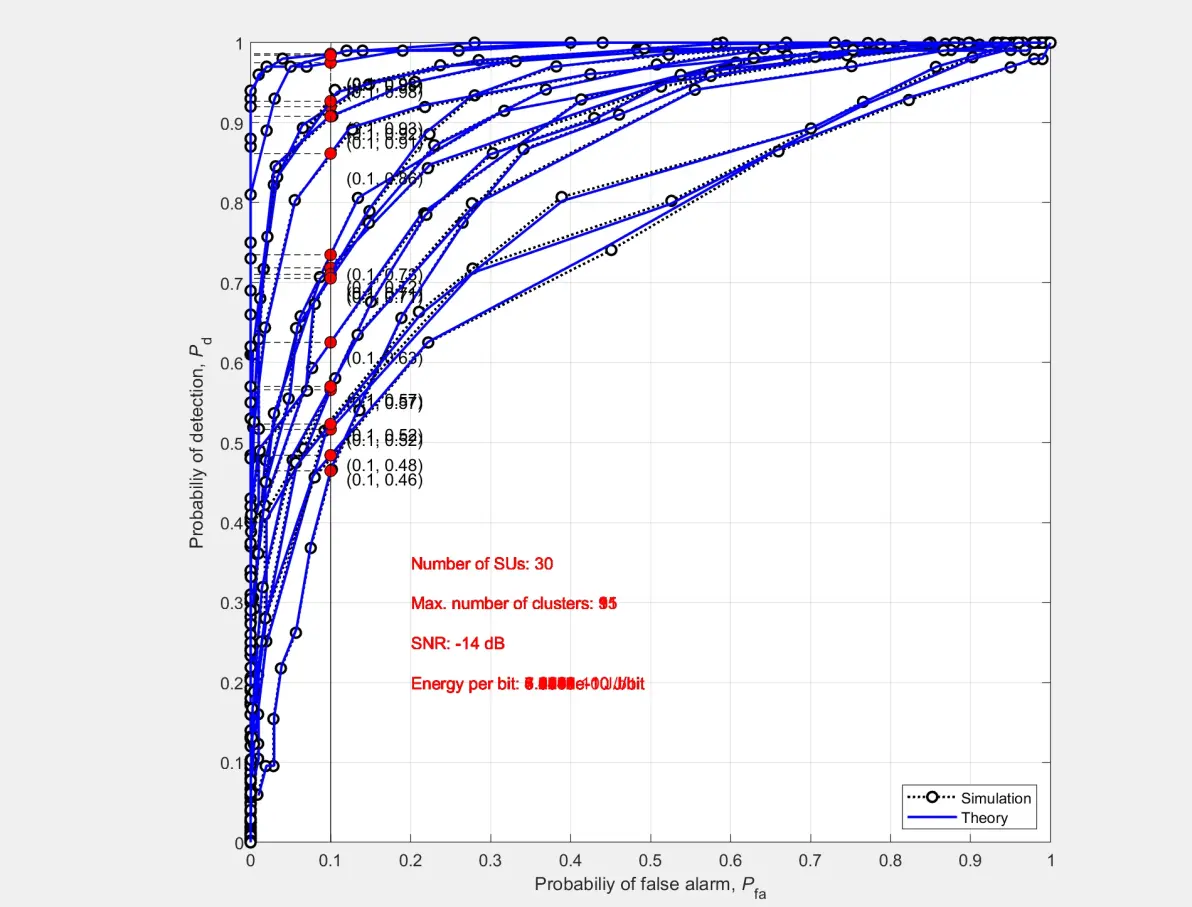
Pietra-Ricci指数(PRI)最初作为经济学和社会科学中衡量不平等性的指标,通过量化数据分布的离散程度反映系统特征。在无线通信领域,该指数被创新性地应用于协作频谱感知场景,形成Pietra-Ricci指数检测器(PRIDe)。其核心原理在于通过分析接收信号样本协方差矩阵的特征值分布差异,区分主用户信号存在与否的状态:
在集中式数据融合协作频谱感知系统中,PRIDe通过以下流程实现高效决策:
编辑
编辑
编辑
编辑
部分代码:
%% System parameters %%%%%%%%%%%%%%%%%%%%%%%%%%%%%%%%%%%%%%%%%%%%%%%%%%%%%%%%%%%%%%%
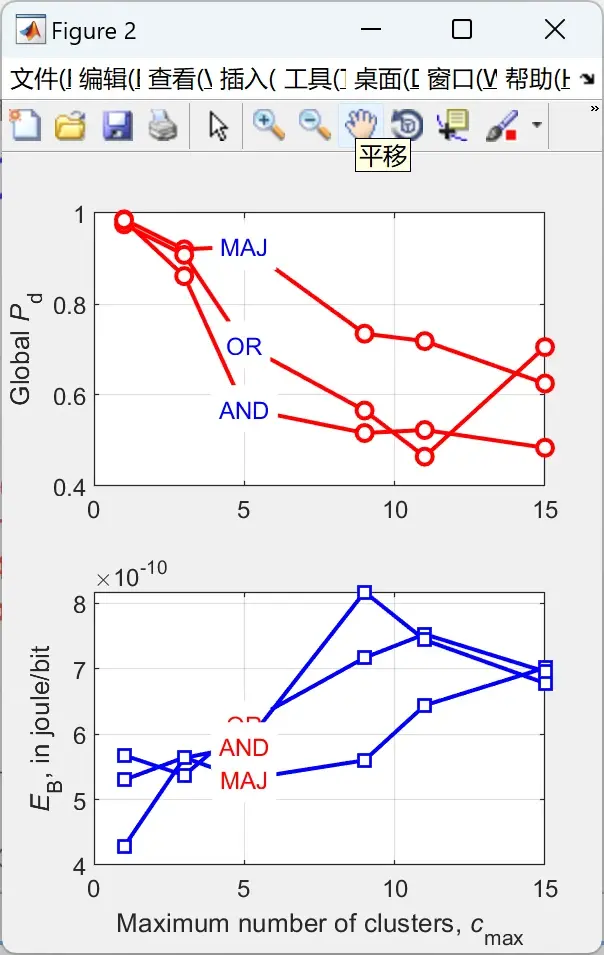
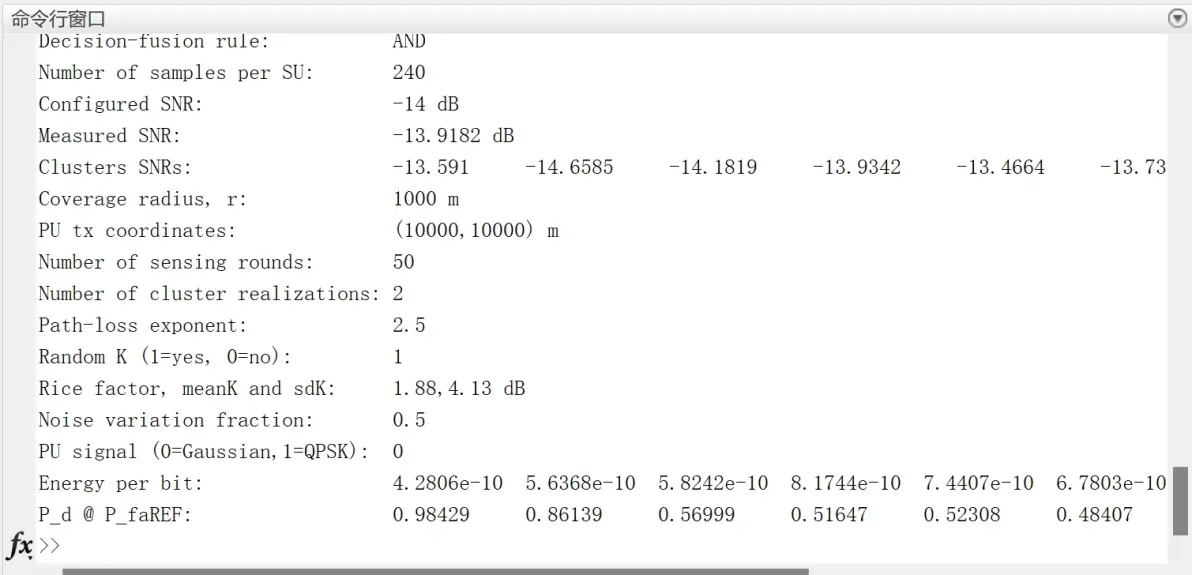
m_T = 30; % Total number of SUs. c_max = 5; % Maximum number of clusters. SNR = -14; % Average signal-to-noise ratio over all SUs, dB. Fusion = RULE(rule); % Decision-fusion rule ("OR", "AND" or "MAJ"). eta = 2.5; % Path-loss exponent. r = 1000; % Coverage radius, m. d0 = 0.001*r; % Reference distance for path-loss calculation, m. runs = 50; % Number of events for computing the empirical CDFs. Sets = 2; % Number of realizations of cluster sets. R_b = 100000; % Secondary network bit rate, bit/s. P_s = 1.0*10^-6; % Power dissipated per SU during sensing, W. tau = 2.0*10^-4; % Frame duration, s. tau_s = 2.0*10^-5; % Sensing interval (common for all SUs), s. tau_rSU = 1.1*10^-6; % Report interval of each SU to CH or each SU to FC (data-fusion), s. tau_rCH = 0.9*10^-6; % Report interval of each CH to FC (decision-fusion), s. P_rxCHdBm = -100; % CH rx sensitivity, dBm. P_rxFCdBm = -100; % FC rx sensitivity, dBm. P_txPU = 5; % PU tx power, W. xPU = 10*r; % x-coordinate of the PU tx, m. Equal to y-coordinate B = 6*10^6; % PU signal bandwidth, Hz. n = ceil(tau_s*2*B); % Number of samples per SU (n = tau_s*2*B). T = n/10; % Number of samples per QPSK PU symbol (n/T must be integer). rho = 0.5; % Fraction of noise power variations about the mean. meanK = 1.88; % Mean of Rice factor for variable K over the runs and SUs, dB. sdK = 4.13; % Standard deviation of K over the runs and SUs, dB. randK = 1; % If randK = 1, K is random; if randK = 0, K = meanK. PUsignal = 0; % PU signal: "0" = iid Gaussian; "1" = niid (T>1) or iid (T=1) QPSK. Npt = 30; % Number of points on the ROCs. P_faREF = 0.1; % Reference P_fa for P_d calculation.
%%%%%%%%%%%%%%%%%%%%%%%%%%%%%%%%%%%%%%%%%%%%%%%%%%%%%%%%%%%%%%%%%%%%%%%%%%%%%%%%%%%%%%%%%
%% Below, enable only the set of parameter values to be varied: %---------------------------------------------------------------------------------------- % Parameter=[1,3,5,11,17,25]; m_T=50; SNR=-15; Flag=1; % For varying c_max. % Parameter=[1,3,5,11,15,20]; m_T=40; SNR=-15; Flag=1; % For varying c_max. Parameter=[1,3,5,9,11,15]; m_T=30; SNR=-14; Flag=1; % For varying c_max. % Parameter=[1,3,5,7,9,11]; m_T=20; SNR=-11; Flag=1; % For varying c_max. % Parameter=[1,3,5,7]; m_T=10; SNR=-10; Flag=1; % For varying c_max. %---------------------------------------------------------------------------------------- % Parameter=[10,15,20,25,30]; c_max=5; SNR=-11; xPU=r; Flag=2; % For varying m_T. % Parameter=[10,15,20,25,30]; c_max=5; SNR=-11; xPU=10*r; Flag=2; % For varying m_T. %---------------------------------------------------------------------------------------- % Parameter=[1,1.5,2,2.5,3,3.5]; m_T=20; c_max=5; SNR=-10; xPU=r; Flag=3; % For varying eta. % Parameter=[1,1.5,2,2.5,3,3.5]; m_T=20; c_max=5; SNR=-10; xPU=10*r; Flag=3; % For varying eta. %---------------------------------------------------------------------------------------- % Parameter=[0,r,3*r,5*r,10*r,15*r]; m_T=20; c_max=5; SNR=-12; eta=2.5; Flag=4; % For varying xPU. % Parameter=[0,r,3*r,5*r,10*r,15*r]; m_T=30; c_max=11; SNR=-12; eta=2.5; Flag=4; % For varying xPU. % Parameter=[0,r,3*r,5*r,10*r,15*r]; m_T=20; c_max=5; SNR=-12; eta=1.5; Flag=4; % For varying xPU. %----------------------------------------------------------------------------------------
for test = 1:size(Parameter,2) % the variable 'text' indexes the parameter varied disp( [ 'Parameter value: ', num2str(Parameter(test))]); % Display the parameter varied
免责声明:本文系网络转载或改编,未找到原创作者,版权归原作者所有。如涉及版权,请联系删
 技术文档
技术文档
 推荐好文
推荐好文






 155-2731-8020